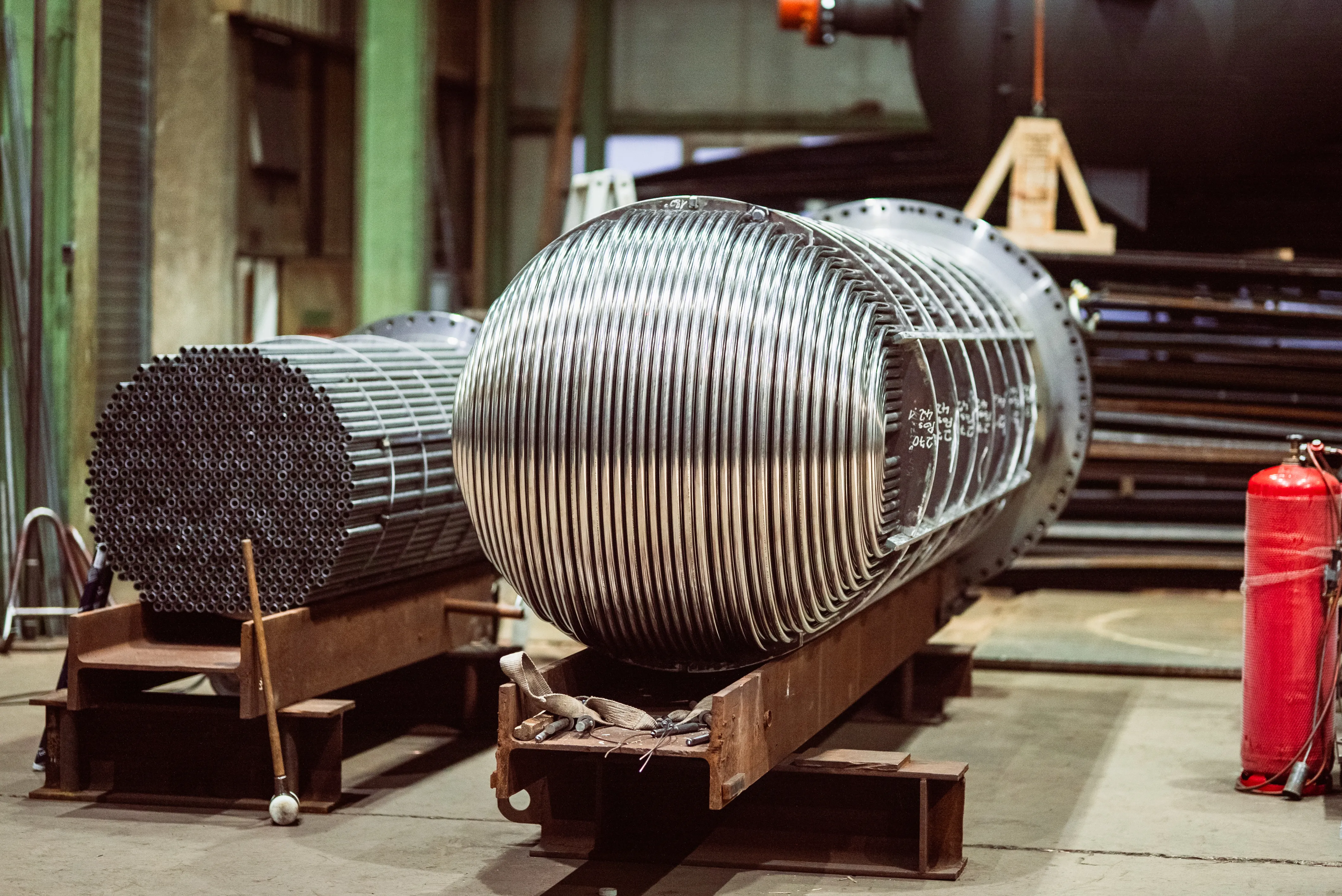
heat exchanger
To ensure maximum thermal efficiency and a long service life, we manufacture custom heat exchangers in a wide variety of designs that can withstand thermal stresses and corrosive media over the long term. Upon request, we can also handle coating, insulation, piping connections, and design.
Maximum thermal output, consistently safe operation
We manufacture heat exchangers for a wide variety of applications in the process industry, custom-built according to customer drawings and specific application requirements. They reliably withstand large temperature differentials, operating pressures on both the tube and shell sides, and aggressive media, and are designed for high temperatures, varying loads, and thermal cycles. Tight manufacturing tolerances, end-to-end material traceability, and comprehensive test documentation ensure that every heat exchanger remains permanently leak-tight and meets testing standards, even under fluctuating thermal loads.
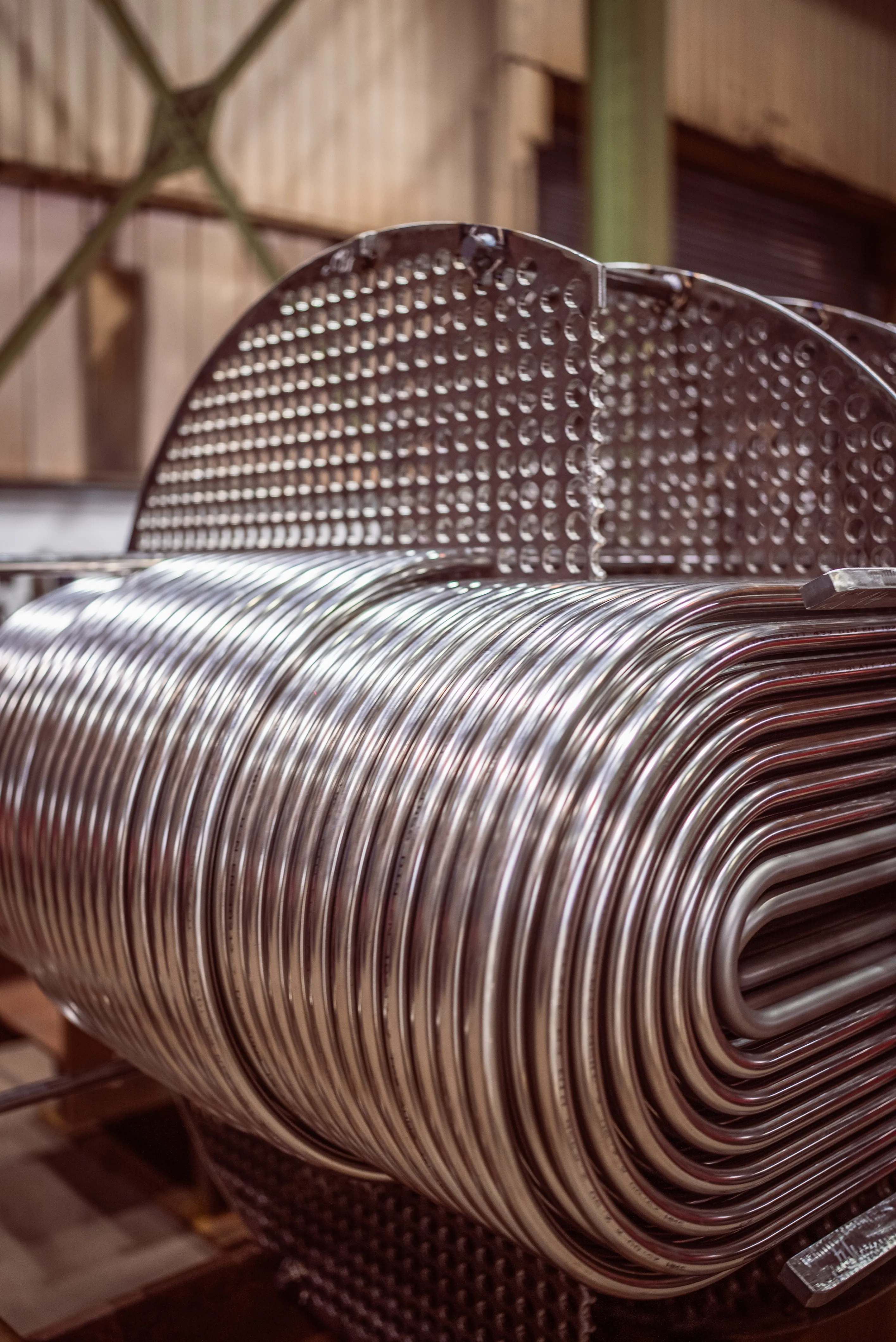
Manufacturing Details
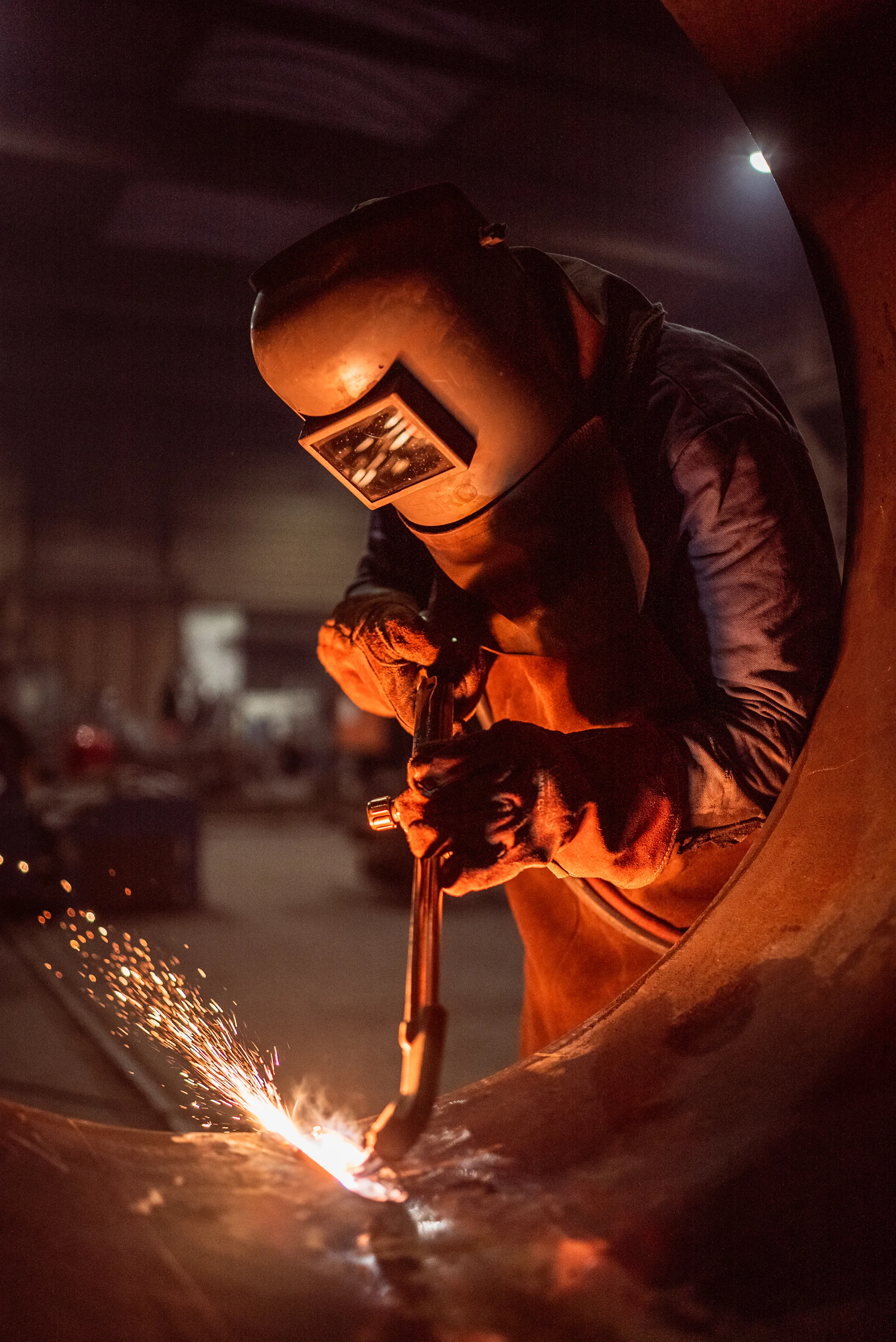
From compact individual units to large bundle constructions, we manufacture precisely according to your specifications, using materials and wall thicknesses designed for the specific medium, pressure, and temperature.
Dimensions
- Diameter: up to 4 m
- Single-piece length: up to 20 m
- Unit weight: up to 150 metric tons
- Wall thickness: up to 100 mm
- Can be produced in multiple parts
In specific cases, we are happy to evaluate the feasibility of larger dimensions, special materials, and customized additional services. Please contact us—we will work with you to develop a suitable solution, including process engineering design, tailored to your specific application.
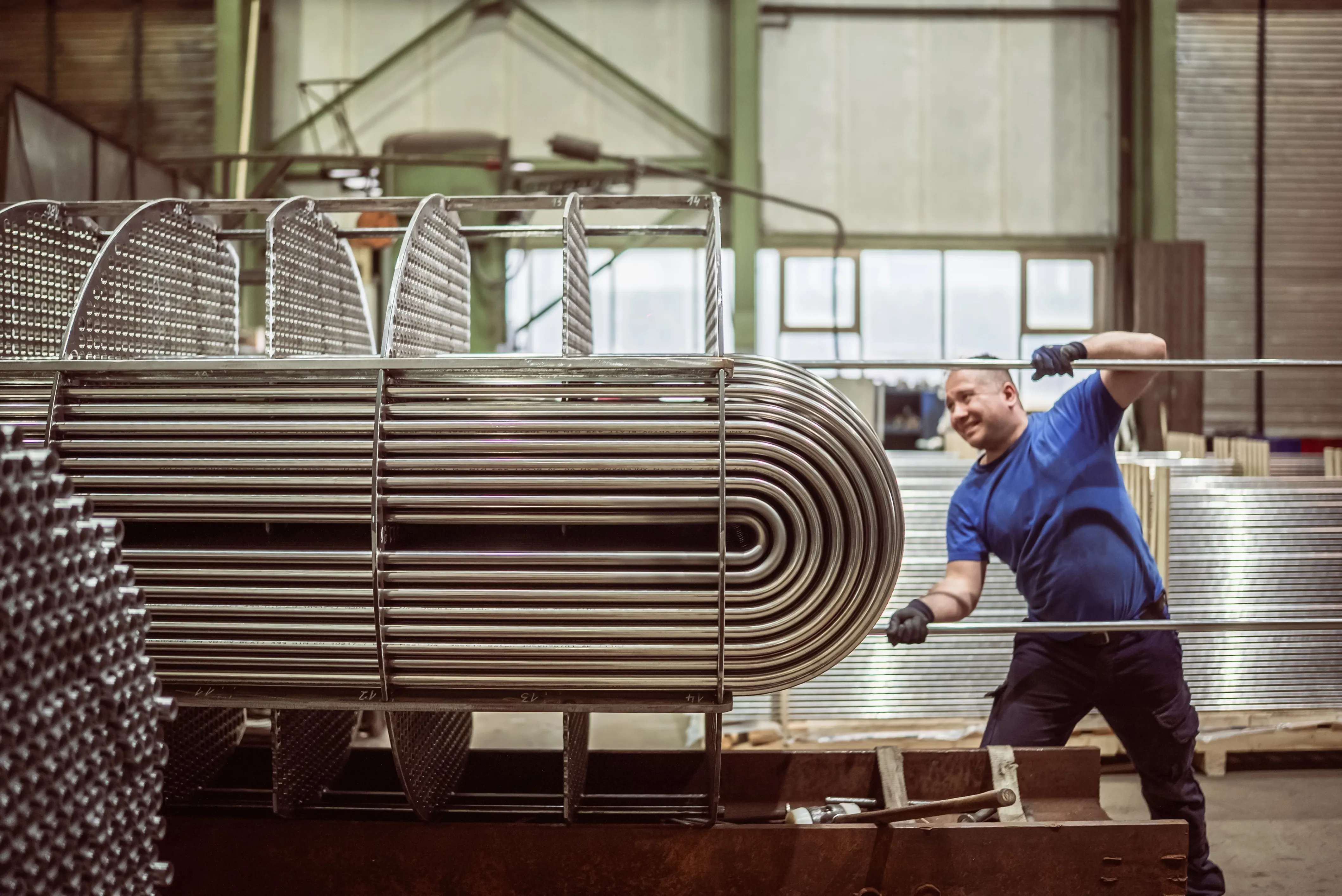
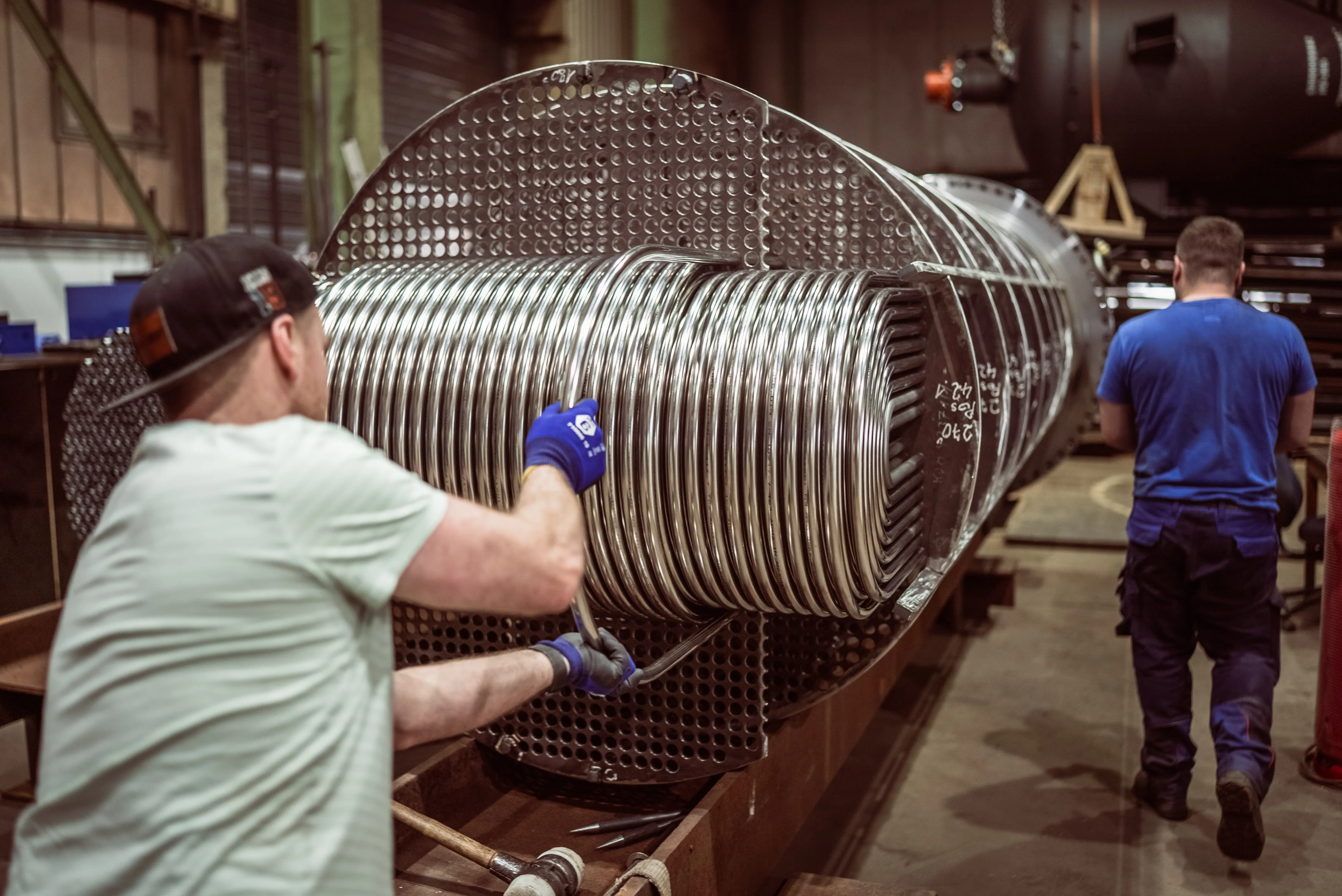
Possible additional services
Piping and welded cladding; internal coatings (e.g., baked-on coatings or food-grade plastic coatings); external coatings (e.g., TSA coatings or CUI); fire-resistant coatings (e.g., Chartek or Firetex); insulation for thermal, refrigeration, electrical, and fire protection; drying and preservation
quality assurance (QA)
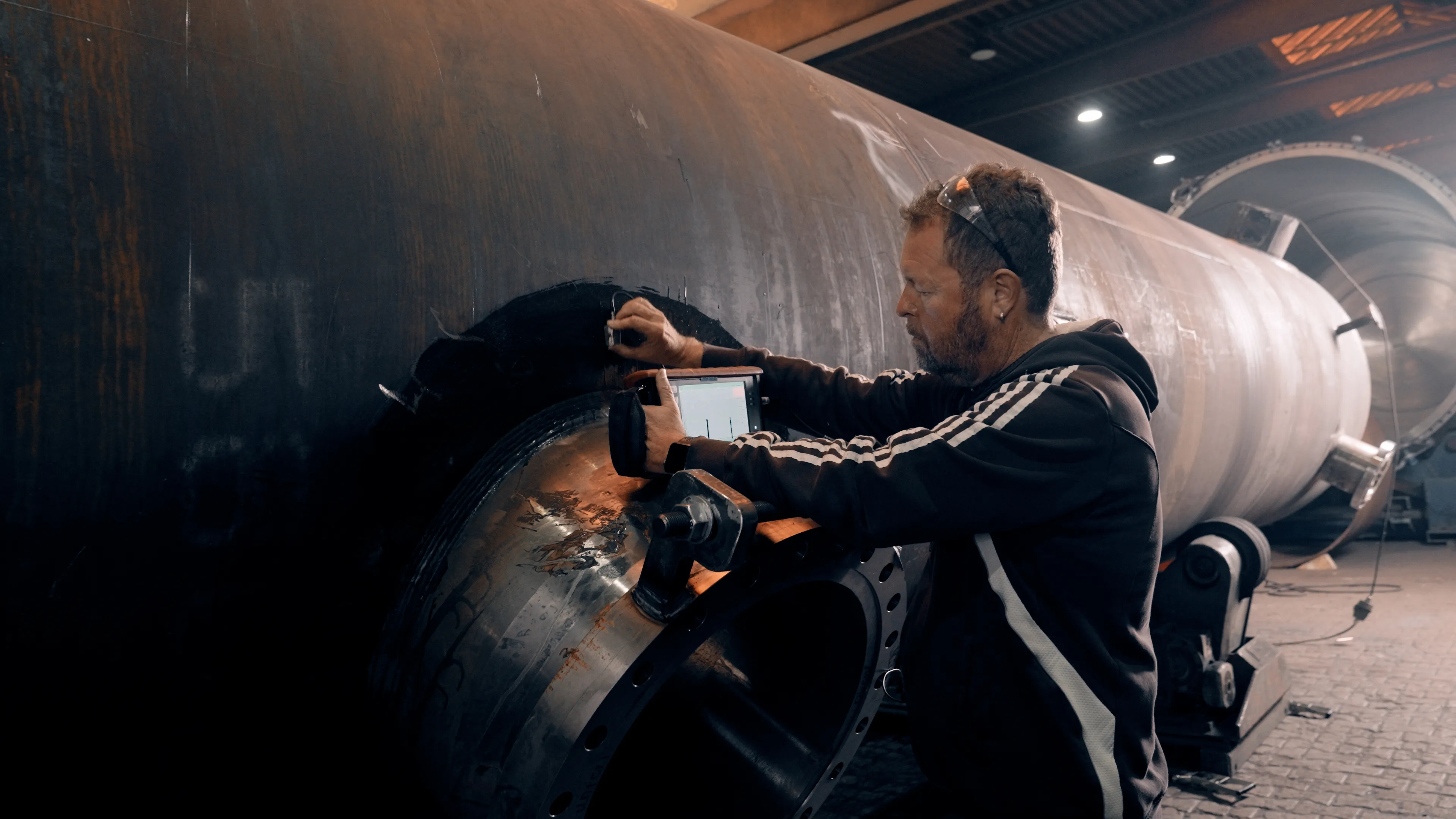
quality assurance (QA) At our company, a team of in-house certified inspectors handles this, covering a broad spectrum non-destructive and destructive testing methods, precise 3D measurement, and complete batch traceability. This ensures that every component meets our quality standards and complies with applicable regulations.
For a comprehensive and audit-ready Documentation Handled by our own team. All materials, components, and filler metals remain traceable; all documentation is stored in an audit-proof manner and prepared in accordance with standards and individual customer requirements.
Design in accordance with standards
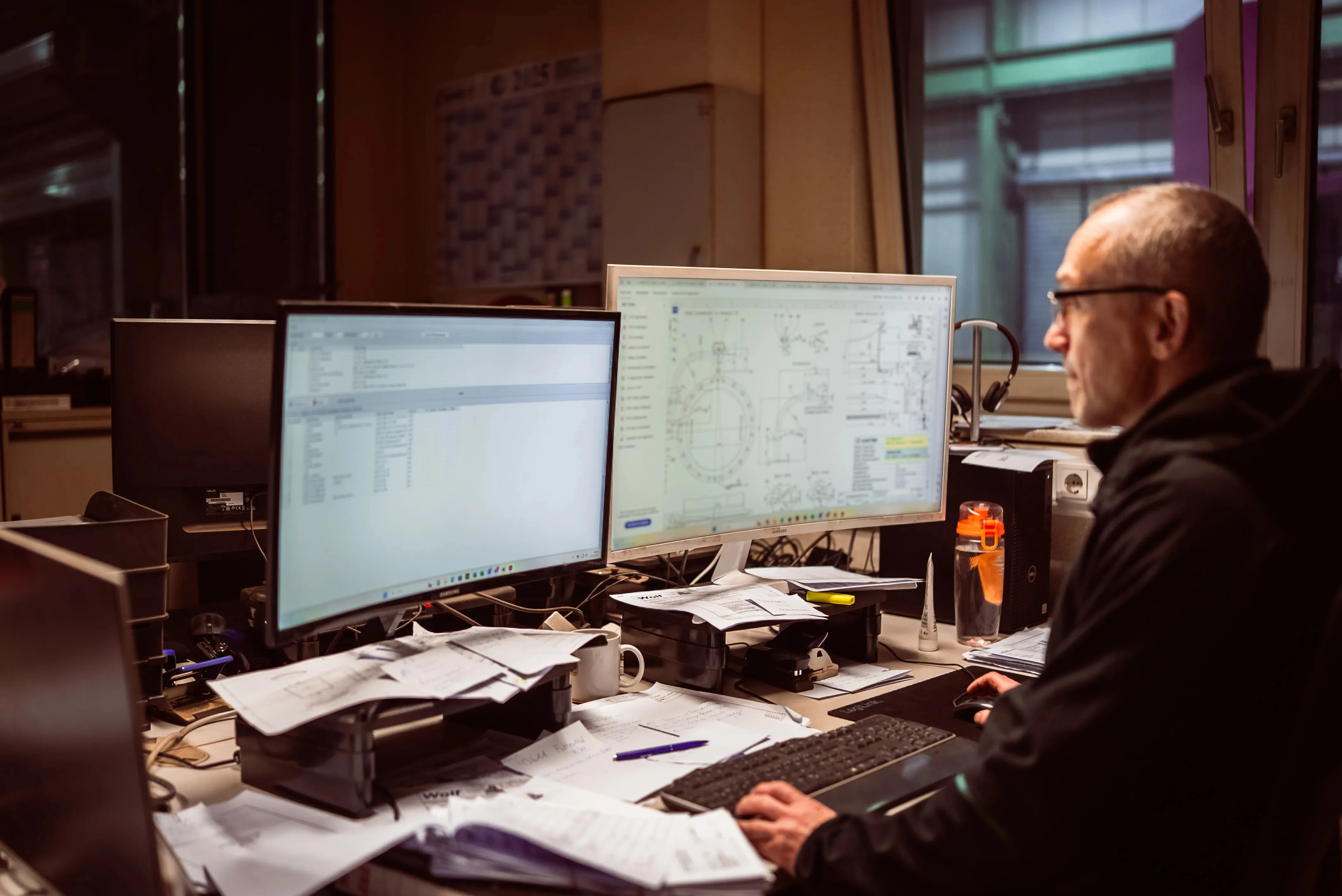
- Design of heat exchangers in accordance with all standards using Lauterbach Verfahrenstechnik Version 11
- Design of pressure vessels in accordance with all standards using Dimy6
- Design of pressure vessels according to ASME U and U2 using Compress 2025
- Design of pressure vessels in accordance with AD2000 and EN13445 using Sant'Ambrogio NextGen 2025
- FEM and CFD in accordance with all standards using ANSYS Mechanical Pro and Fluent 2025 R1
- FEM analysis in accordance with all standards using Nozzle-Pro 15
- Design of flanges according to EN 1591-1 using TEMESfcal
- Design of pressure vessels using PTC Creo
Carbon, stainless, and duplex steels
Carbon steels
P 265 GH, P 355 GH, P 355 NH, P 355 NL1, 16 Mo 3, 13 CrMo 4-5, 10 CrMo 9-10, 15 NiCuMoNb 5-6-4, SA-516 Gr. 60, SA-516 Gr. 70, SA-350 LF2, SA-387 Gr. 11
Stainless steels
1.4301, 1.4541, 1.4571, 1.4539, SA-240-304, SA-240-321, SA-240-316 Ti, and SA-240-904 L
Duplex steels
1.4462 and SA-240 - 318 LN
Excellent.
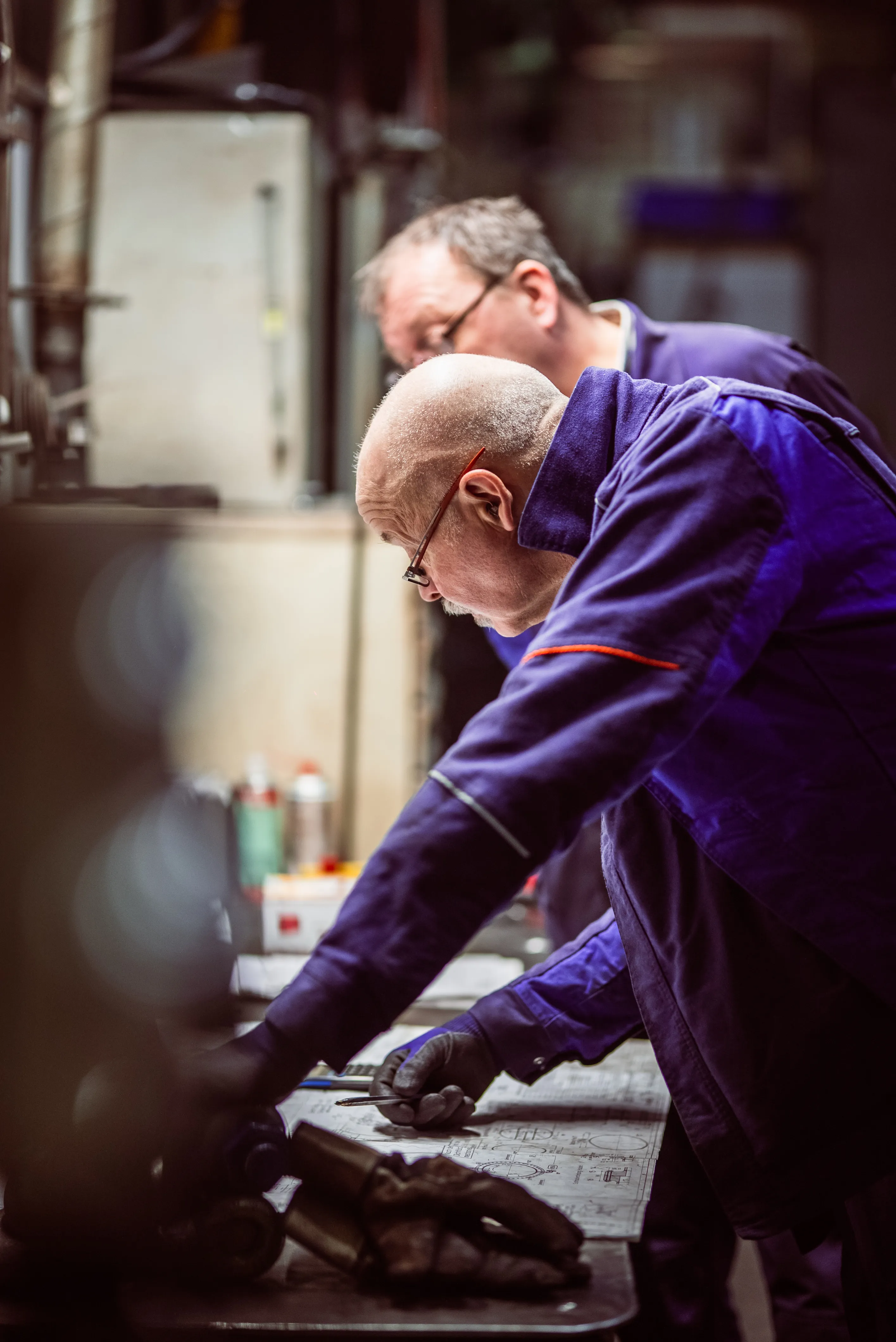
Any questions? We’re here to help you personally.
At WOLF Vessel and Apparatus Construction, you and your projects are our top priority. You can always count on our consistently high product quality and our comprehensive service.
Kai Jaspert
Leiter Vertrieb
Questions about our heat exchangers
What dimensions are feasible? Which materials are suitable for highly corrosive processes? To help you with the design process, we have compiled the most common technical questions regarding the construction, tube bundles, and ease of maintenance of our heat exchangers.
Can you also design heat exchangers? + − Yes, we also offer the design and calculation of heat exchangers. With Lauterbach 11, we carry out detailed calculations for the design of heat exchangers to ensure optimum efficiency and safety.
Yes, we also offer the design and calculation of heat exchangers. With Lauterbach 11, we carry out detailed calculations for the design of heat exchangers to ensure optimum efficiency and safety.
Do you also offer customized solutions for specific applications? + − Yes, we offer customized solutions for various industrial applications, particularly for critical sectors of the chemical and energy industries. We take all technical requirements into account and provide comprehensive solutions ranging from design to testing procedures and documentation.
Yes, we offer customized solutions for various industrial applications, particularly for critical sectors of the chemical and energy industries. We take all technical requirements into account and provide comprehensive solutions ranging from design to testing procedures and documentation.
What certifications and accreditations does your company have? + − We are certified according to international standards to ensure the highest quality and safety:
- DIN ISO 9001 (Quality Management)
- PED 2014/68/EU (Pressure Equipment Directive)
- EN 13445 (Pressure vessel construction)
- AD 2000 (German standard for pressure vessels)
- ASME U1, U2, and S stamps (for pressure vessel construction according to U.S. standards / pressure vessels and piping)
- EN 1090-1/-2 (Construction of load-bearing steel structures)
- DIN EN ISO 3834 (Welding Technology)
We are certified according to international standards to ensure the highest quality and safety:
- DIN ISO 9001 (Quality Management)
- PED 2014/68/EU (Pressure Equipment Directive)
- EN 13445 (Pressure vessel construction)
- AD 2000 (German standard for pressure vessels)
- ASME U1, U2, and S stamps (for pressure vessel construction according to U.S. standards / pressure vessels and piping)
- EN 1090-1/-2 (Construction of load-bearing steel structures)
- DIN EN ISO 3834 (Welding Technology)
How to maximize the efficiency of a heat exchanger in a company? + − Efficiency can be maximized by:
- Regular maintenance and inspection
- Optimization of flow conditions and temperature differences
- Implementation of heat recovery systems
- Selection of the right type of heat exchanger depending on the application requirements
Efficiency can be maximized by:
- Regular maintenance and inspection
- Optimization of flow conditions and temperature differences
- Implementation of heat recovery systems
- Selection of the right type of heat exchanger depending on the application requirements